
If you’ve ever placed a bet in Malaysia, you might have wondered, “How do bookmakers actually make money?” or “What does that margin on my bet slip mean?” Well, today we’re diving deep into the world of bookmaker margins, explaining exactly how they work, why they exist, and how you can calculate them to make smarter betting decisions.
What Is a Bookmaker Margin?
A bookmaker margin, sometimes called overround or vig, is essentially the profit built into the odds by the bookmaker. Think of it like the house edge at a casino—without it, the bookmaker would break even on every event. This margin ensures that no matter the outcome of a game or match, the bookmaker has a small guaranteed profit. It’s not a trick or a scam; it’s just how sportsbooks stay in business while covering the risk of uneven betting. For bettors, understanding this margin is key to knowing exactly how much you’re paying above the fair odds.
In simple terms, when you place a bet, the odds you see already include this margin. That means the numbers aren’t just a reflection of the likelihood of each outcome—they’re slightly adjusted to favor the bookmaker. For instance, if you bet on a football match where both teams seem evenly matched, you might see odds like 1.90 for each side. Those odds suggest each team has a 50% chance of winning, but the bookmaker has already built in a small profit that slightly reduces your potential payout.
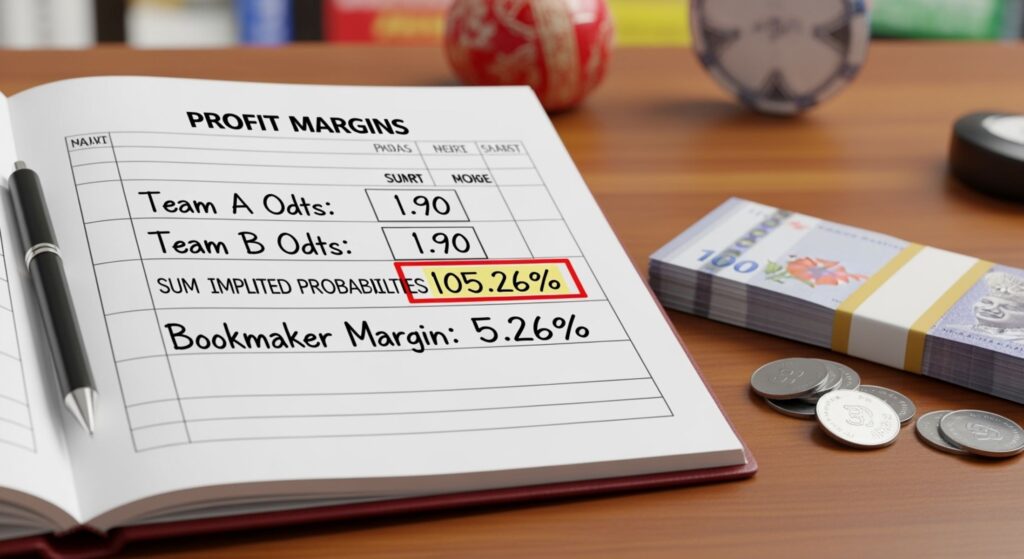
Let’s break it down with a quick example. Suppose you have a match between Team A and Team B. If both teams are considered equally likely to win, the “true probability” would be 50% for each side. In decimal odds, that would translate to 2.00 for each team. But in reality, the bookmaker might offer odds of 1.90 for both teams. At first glance, it seems fair, but if you calculate the implied probabilities, they total more than 100%, showing the bookmaker’s margin. This extra percentage is essentially the bookmaker taking a small cut from every bet.
This margin affects every single bet, whether it’s a simple match winner, a draw, or a complex multiple-outcome market. Even though the difference might seem small—often just 5–10%—it adds up over time, especially for frequent bettors. Being aware of the margin helps you compare different bookmakers, spot value bets, and make smarter decisions. After all, betting isn’t just about luck; it’s also about knowing the hidden costs built into the odds and finding the best possible return for your money.
Why Bookmakers Add Margins
- Bookmakers need to cover risk. In any sporting event, large amounts of money can be wagered on one side, creating a potential imbalance. By adding a margin to the odds, bookmakers can ensure that they don’t lose money if one outcome is heavily favored. This margin acts as a cushion, allowing the bookmaker to pay winners even if the majority of bets are concentrated on a single result.
- Margins guarantee profit. The primary goal of any bookmaker is to make money, and the margin is essentially the built-in profit on every bet. Even if the event ends in an unexpected way, the bookmaker still earns a small percentage from all the wagers placed. This ensures the business remains sustainable and can continue offering betting markets without risking financial losses.
- Margins help bookmakers handle errors or adjustments. Sports events can be unpredictable. Last-minute injuries, weather changes, or sudden lineup switches can alter the odds dramatically. By including a margin, bookmakers create a buffer to protect against sudden market shifts or mistakes in the initial odds calculation. This extra layer of security ensures that unexpected events don’t wipe out their profits.
- Margins allow bookmakers to offer competitive odds while managing their exposure. While it may seem like they are just taking a cut, the margin actually gives them the flexibility to provide attractive odds for bettors without risking too much on any single outcome. It’s a balancing act: they want to stay appealing to customers while protecting their bottom line.
- Margins cover operational costs and business sustainability. Beyond just paying winners, sportsbooks have staff, technology, licensing fees, and other operational expenses. The margin helps cover these costs while keeping the platform profitable. Without it, sportsbooks would struggle to maintain their operations, especially with unpredictable betting patterns.
- Think of margins like insurance for the bookmaker. They’re paying a small “premium” on every bet to ensure stability, just like an insurance company spreads risk across many policies. This way, no matter which team wins or loses, the business remains secure and able to operate efficiently.
How to Calculate Bookmaker Margins
| Team / Outcome | Decimal Odds | Implied Probability (%) | Explanation | Contribution to Margin (%) |
| Team A Wins | 1.90 | 52.63 | Decimal odds are converted to implied probability using 1 ÷ Odds × 100 | 2.63 (Extra over 50%) |
| Team B Wins | 1.90 | 52.63 | Same calculation as Team A; reflects bookmaker’s built-in cut | 2.63 (Extra over 50%) |
| Total Probability | — | 105.26 | Sum of all implied probabilities exceeds 100% due to bookmaker margin | 5.26 (Total margin) |
| Margin Formula | — | — | Margin (%) = Sum of Implied Probabilities − 100 | Shows the bookmaker’s profit buffer |
| Interpretation | — | — | The 5.26% margin means the bookmaker has built in a profit on this market; the higher this value, the more cost is indirectly added to each bet | Guides bettors in evaluating value |
Understanding Malaysian Odds Formats
In Malaysia, sports bettors encounter a variety of odds formats, including decimal odds, Malay odds, and sometimes Hong Kong odds. Each format presents the same basic information—the potential return on a bet—but in different ways. Understanding these formats is essential for calculating bookmaker margins accurately, comparing odds across different platforms, and making informed betting decisions. While decimal odds are the most straightforward and widely used in online sportsbooks, Malay odds can be trickier for beginners and require careful conversion to understand the implied probability.
Decimal odds are simple and intuitive, making them the standard choice for many online betting platforms in Malaysia. They show the total return for every 1 unit staked, including your original stake. For example, decimal odds of 1.90 mean that a successful 1 MYR bet would return 1.90 MYR in total, which includes 0.90 MYR profit. The formula for converting decimal odds to implied probability is straightforward: 1 divided by the decimal odds, multiplied by 100. This simplicity makes decimal odds ideal for calculating bookmaker margins, comparing potential returns, and spotting value bets.
Malay odds, on the other hand, are a bit more complex. They can be positive or negative, similar to American moneyline odds. Positive Malay odds indicate how much you can win for every 1 unit staked, while negative Malay odds show how much you need to stake to win 1 unit. For example, a positive Malay odd of +0.90 means a 1 MYR bet yields 0.90 MYR profit, whereas a negative odd of -0.90 means you must stake 0.90 MYR to win 1 MYR. This dual system can confuse beginners, but once converted to decimal odds, the calculation of implied probability and bookmaker margin becomes seamless.
To convert Malay odds to decimal odds, you use a simple formula. For positive Malay odds, you add 1 to the Malay value (1 + Malay Odds). For negative Malay odds, you take the reciprocal of the absolute value, then add 1 (1 + 1/|Malay Odds|). This ensures that all odds are in a comparable decimal format, which can then be used to calculate the bookmaker’s margin or identify value bets. Mastering these conversions is crucial for Malaysian bettors who want to compare different sportsbooks, understand how much they’re paying in built-in margins, and make strategic decisions that maximize potential returns.
Example of a Full Calculation
- Consider a football match in Malaysia between Johor Darul Ta’zim and Selangor, where we want to calculate the bookmaker margin for the betting market.
- The first outcome is Johor Darul Ta’zim Wins, with decimal odds of 1.75. Converting these odds to implied probability gives 57.14%, which reflects the bookmaker’s assessment of the team’s chance to win, including their built-in margin.
- The second outcome is a Draw, with decimal odds of 3.60. This converts to an implied probability of 27.78%, showing how the bookmaker balances the market between all possible results.
- The third outcome is Selangor Wins, with decimal odds of 4.20, translating to an implied probability of 23.81%. This completes the set of possible outcomes for the match.
- To calculate the total probability, sum all the implied probabilities: 57.14% + 27.78% + 23.81% = 108.73%. Notice that this exceeds 100%, which indicates the bookmaker’s margin is included in the odds.
- Next, subtract 100% from the total probability to determine the margin: 108.73% − 100% = 8.73%. This 8.73% represents the bookmaker’s built-in profit on this market.
- This margin ensures that the bookmaker earns a small profit regardless of which outcome occurs, providing a buffer against large losses or uneven betting patterns.
- Understanding this margin helps bettors evaluate whether the odds offer good value, and allows them to compare different sportsbooks to find the best potential returns.
- Even though the difference seems small, over multiple bets, the margin can significantly affect a bettor’s long-term profitability.
- By calculating and analyzing margins like this, Malaysian bettors can make smarter betting decisions, identify value bets, and avoid markets where the bookmaker’s edge is excessively high.
Why Margins Differ Across Sports
| Sport | Typical Margin (%) | Reason for Margin | Example in Malaysia | Impact on Bettors |
| Football | 5–8 | Highly popular sport; more betting volume reduces margin | Malaysia Super League, Malaysia Cup | Lower margins mean better value bets for most matches |
| Basketball | 6–9 | Slightly less predictable than football | ASEAN Basketball League matches | Bettors need to account for slightly higher house edge |
| Tennis | 5–7 | Frequent matches with clear favorites reduce risk | ATP/WTA tournaments in Malaysia coverage | Moderate margins; good for experienced bettors tracking form |
| Badminton | 4–6 | Popular but very predictable in top matches | Malaysia Open, Thomas & Uber Cups | Low margins make value bets easier to identify |
| Horse Racing | 10–15 | Highly unpredictable; lower betting volume on specific races | Malaysian Turf Club races | High margins reduce potential returns; bettors need caution |
| Esports | 6–12 | Newer market; volatility and lower liquidity affect odds | Mobile Legends, Dota 2 tournaments in Malaysia | High variability; margins fluctuate depending on popularity |
| MMA / Combat Sports | 7–10 | Unpredictable outcomes; injuries and last-minute changes | ONE Championship events | Higher margins require careful odds comparison |
| Motorsports | 8–12 | Very unpredictable events; fewer participants | Malaysian Grand Prix, local karting events | Bettors face higher house edge; risk management is key |
Impact of Margin on Your Betting
Bookmaker margins might seem small at first glance, often ranging from 5% to 10%, but their impact compounds significantly over time. Each bet you place carries a tiny hidden cost due to the margin, meaning that even if you consistently pick winners, the built-in bookmaker edge slowly reduces your overall returns. For instance, a $100 bet with a 5% margin may only return slightly less than the true odds, but over dozens of similar bets, that small difference can add up to a noticeable reduction in your potential profit.
When margins increase, the effect becomes even more pronounced. A $100 bet at a 10% margin doesn’t just reduce your expected payout slightly—it can dramatically lower your long-term returns if you make frequent bets. This is especially relevant in Malaysian sports markets, where high-margin events like horse racing or smaller esports tournaments can significantly diminish profitability. Sharp bettors understand that even a seemingly minor margin difference between two sportsbooks can influence which platform is most advantageous for their wagers.
High margins also affect strategy when looking for value bets. Even if you identify a bet with a probability higher than the implied odds, the margin effectively raises the “break-even point” you need to overcome to make a profit. In other words, the bookmaker’s cut forces you to be even more selective with your bets. Malaysian bettors who ignore margins may think they are getting a fair deal, but in reality, the house edge silently erodes potential earnings over time, especially in markets with frequent bets or complex multi-leg wagers.
Being aware of bookmaker margins empowers you to make smarter betting decisions. By comparing odds across multiple sportsbooks and calculating implied probabilities, you can identify where the margin is lowest and maximize your returns. Experienced Malaysian bettors treat margin analysis as a core part of their strategy, combining it with knowledge of the sport, recent team performance, and betting trends. Ultimately, understanding how margins impact payouts helps bettors avoid overpaying unknowingly and ensures that every bet has the best possible value.